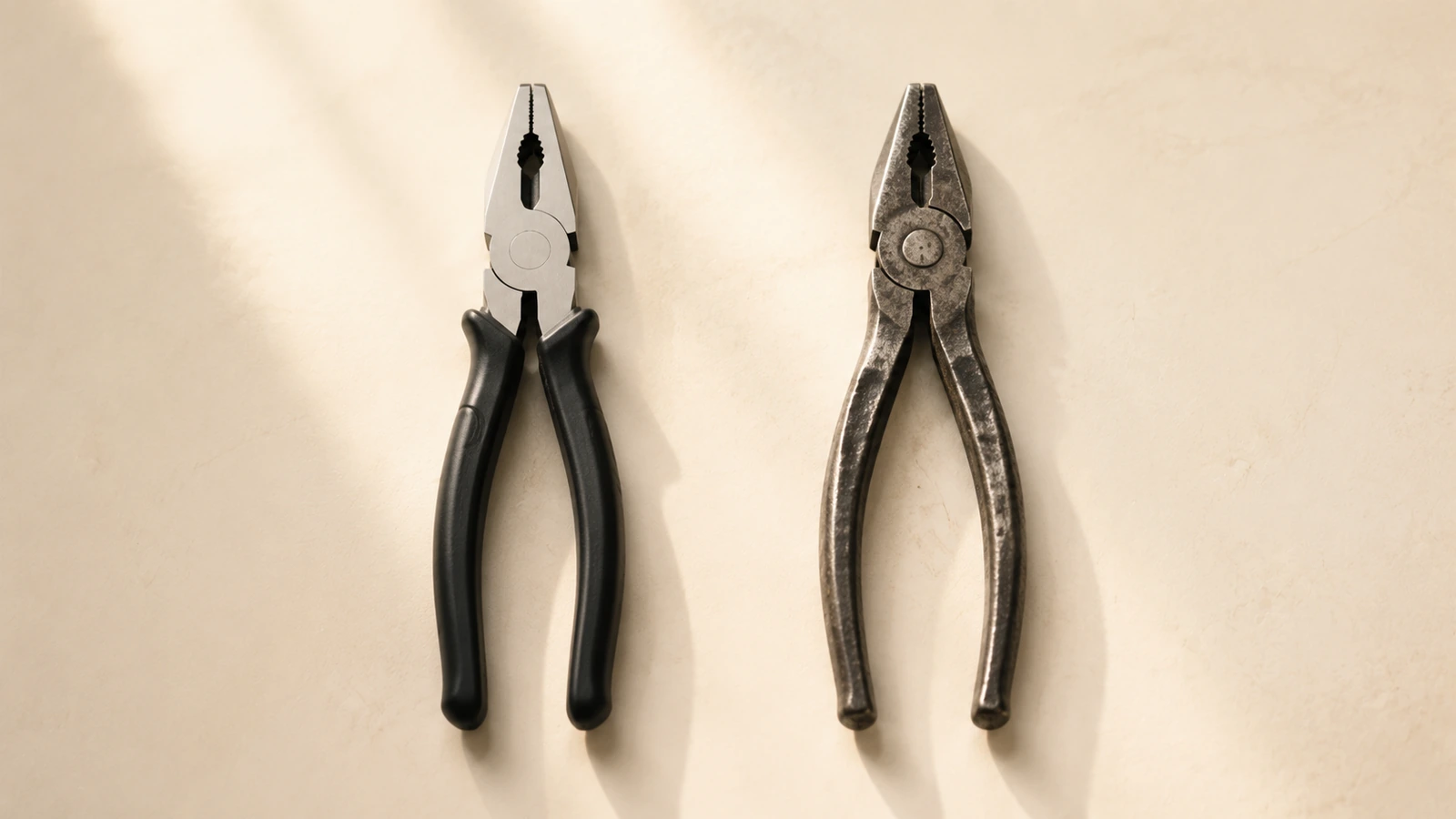
I’ve spent twenty years in product design, which mostly means twenty years watching people argue about tools when the tool was never the problem.
So I want to be fair about this one. Wix, Squarespace, GoDaddy’s builder, all of them. They are legitimately impressive pieces of software. Building a website used to require a developer and now it requires an afternoon. That’s a real thing and I’m not going to pretend otherwise.
But every tool makes a trade, and it’s worth knowing which trade you made.
The trade
A page builder is optimized for one thing: letting somebody with no technical background produce something acceptable without help.
That’s a genuinely hard problem and they solved it. But to solve it, the builder has to make a lot of decisions on your behalf and then load the machinery for every decision it might make, on every page, for every visitor, forever.
That machinery is the cost. It shows up in four places.
1. Speed
A page builder site is carrying code for a thousand features you’ll never use. The animation library you didn’t enable, the store you don’t have, the booking system you skipped. It ships anyway.
Real world result: a hand-coded page loads in about a second on a phone. A typical builder site takes three to six. Sometimes worse on cell data.
That matters because speed is both a ranking factor and a bounce factor. Somebody with a leak in their kitchen doesn’t wait five seconds. They hit back.
2. What Google can read
Google reads your page code. A builder generates deeply nested, machine-written markup that’s harder to parse, and it usually doesn’t produce complete structured data unless you go install a plugin and configure it.
I write that markup by hand, so the LocalBusiness schema, the FAQ schema, the meta descriptions, the alt text, all of it is filled in properly. That’s the layer that decides whether Google understands you’re a plumber in Murrieta with these hours and these services.
This is getting more important, not less. When somebody asks an AI assistant “who’s a good roofer in Temecula,” it’s reading structure. Messy code is now a visibility problem in a way it wasn’t three years ago.
3. Ownership
You can’t export a Wix site. There is no download button that gives you a working website.
Stop paying and it goes away. Want to move to a different host, hire a different developer, hand it to somebody else? You’re rebuilding.
With a hand-coded site you get the actual files. Any competent developer on earth can pick them up, because it’s just HTML and CSS. That’s not a small thing when you’re making a decision you’ll live with for five years.
4. Looking like everybody else
This one’s softer but it’s real. Builders start you from templates, and there are only so many templates, and there are a lot of businesses.
Your customer can’t articulate it, but they can feel when a site looks like the last four they saw. It quietly reads as “this business is like all the others,” which is precisely the opposite of what you were paying for.
When a builder is actually the right call
I’d rather be useful than win an argument, so honestly:
- If your budget for this is genuinely zero right now. A Wix site that exists beats a custom site you can’t afford. Get something up, work your Google listing, and revisit it when there’s money.
- If you need to change the site constantly yourself. A restaurant swapping a menu three times a week wants the editor. That’s a real requirement and it’s what the tool is for.
- If the site is a placeholder, not a lead source. If people find you entirely by referral and the site just needs to confirm you’re real, a builder is fine. Don’t overspend on something that isn’t doing work.
When it’s the wrong call
If your website is supposed to bring you customers you don’t already have, the trade stops making sense. You gave up speed, structure, and ownership in exchange for convenience you only needed once, on the day you built it.
That’s the part that gets me. You’re paying the cost of that convenience every month for years, and you used it for one afternoon.
The check
Whatever you’ve got, run these two tests today.
Load your site on your phone on cell data, not office wifi, and count the seconds.
Then ask whoever built it to send you the files.
Those two answers tell you where you actually stand.